
The 4 x 90 Lens

The 4 x 90 Lens is a first-pass tool for transformational gifts.

It helps refocus the discussion on the conditions most often present around the largest gifts: new wealth creation, proximity, life stage, and demonstrated generosity.

Explore the four signals

Philanthropic capital is in motion.
Will it come to you?
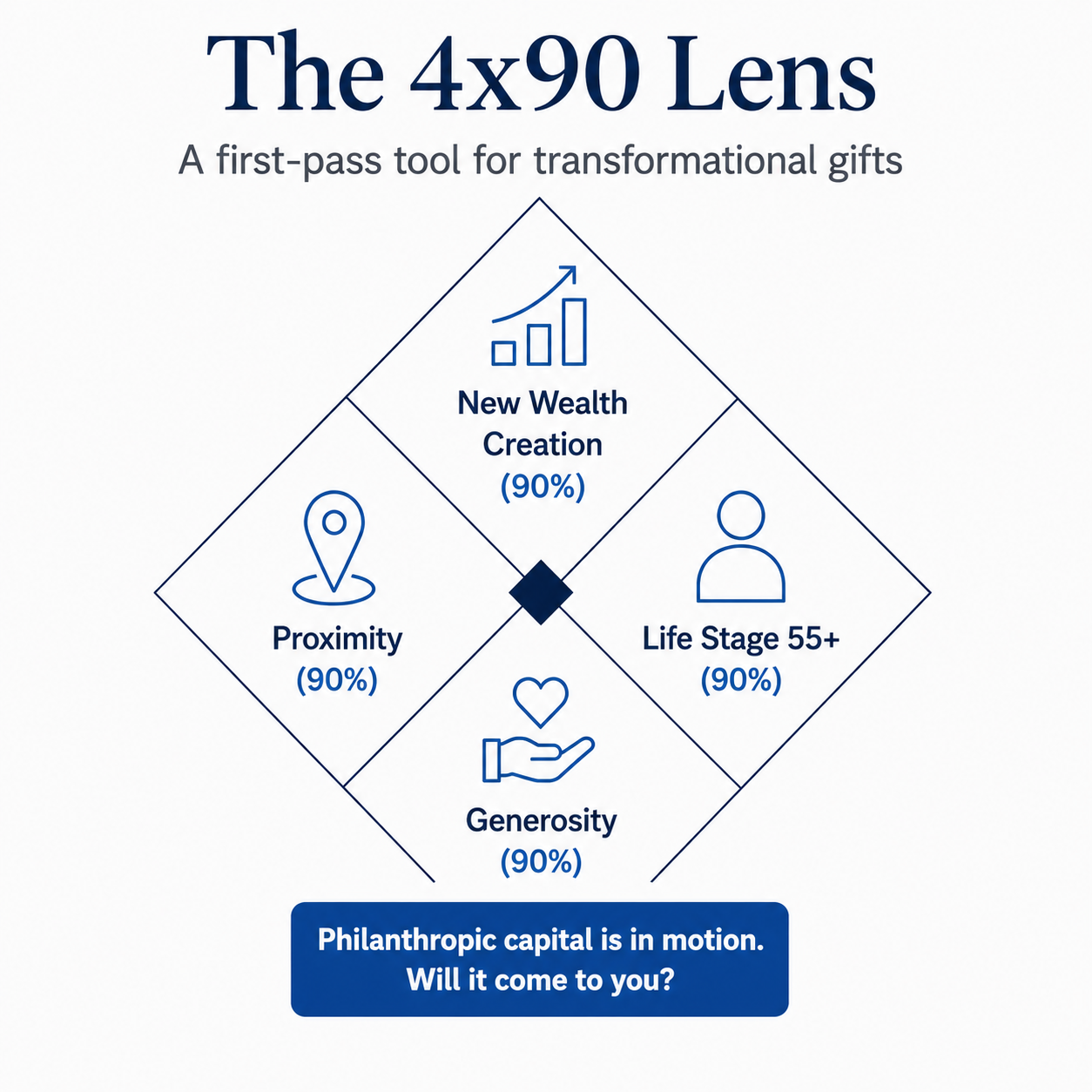
Hover over each quadrant to see the signal behind the lens. On mobile, scroll the four cards below.

Interactive 4 x 90 Lens

Hover or tab through the quadrants.

Start with the conditions

The largest gifts are not random.

Hover over each quadrant to see the conditions most often present around the largest gifts.

New Wealth Creation

Most of advancement is looking for wealth.

The smarter fundraisers are looking for new wealth.

The largest gifts are overwhelmingly tied to newly created wealth. In the study of 252 gifts of $5M+ across 26 universities, 70% of the gifts came from first-generation wealth creators. 20% came from inheritor-growers. Only about 10% came from legacy wealth.

They earned it. They are not beholden to parents or kids about how they are going to spend it. After they have had some short-term fun, they start looking for long-term meaning. How can they pass on the values that made them successful, and generate a societal return?

Proximity

People give most significantly where their life and identity are most connected.

Donors give to what they know, what they see. A sense of place. There is also emotional proximity. They felt close.

The 4 x 90 Lens defines proximity as either being an alum or having a primary residence within 50 miles. Taken together, 90% had either trait. 33% had both.

A gift to a local institution is also a gift to the community itself. Big donors are often looking for ways to make their gift do more.

Life Stage 55+

The largest gifts usually come later.

Young wealth may have real capacity, even real liquidity. But it is very uncommon for young entrepreneurs to make principal gifts. Very, very uncommon.

After age 60, more of life is known. How many children are in the picture? How many grandchildren? Do any have special needs? How much private school and college tuition do they want to take on? Are they building a multi-generational vacation home? How much is enough?

There is a time for wealth accumulation, and a time for wealth distribution. In the 26-university study, 90%+ of $5M+ gifts came from donors over 55. The average age was closer to 75.

Life stage isn’t just the number. It’s the moment when wealth, family, mortality, and meaning converge.

Generosity

Transformational donors are rarely created in adulthood.

The instinct to give is formed early and reinforced over time. Some people possess the philanthropic gene. Others just don't. Are you going to debate them, or spend your time on people who are already switched on?

In the study, 75% had already made a major gift to the institution, and 90% had made a major gift somewhere.

Your strongest prospects are often already known to you — and already giving. A donor who gives $1 million to your organization may give $25 million elsewhere.

New Wealth Creation

Most of advancement is looking for wealth.

The smarter fundraisers are looking for new wealth.

The largest gifts are overwhelmingly tied to newly created wealth. In the study of 252 gifts of $5M+ across 26 universities, 70% of the gifts came from first-generation wealth creators. 20% came from inheritor-growers. Only about 10% came from legacy wealth.

They earned it. They are not beholden to parents or kids about how they are going to spend it. After they have had some short-term fun, they start looking for long-term meaning. How can they pass on the values that made them successful, and generate a societal return?

Proximity

People give most significantly where their life and identity are most connected.

Donors give to what they know, what they see. A sense of place. There is also emotional proximity. They felt close.

The 4 x 90 Lens defines proximity as either being an alum or having a primary residence within 50 miles. Taken together, 90% had either trait. 33% had both.

A gift to a local institution is also a gift to the community itself. Big donors are often looking for ways to make their gift do more.

Life Stage 55+

The largest gifts usually come later.

Young wealth may have real capacity, even real liquidity. But it is very uncommon for young alumni entrepreneurs to make principal gifts. Very, very uncommon.

After age 60, more of life is known. How many children are in the picture? How many grandchildren? Do any have special needs? How much private school and college tuition do they want to take on? Are they building a multi-generational vacation home? How much is enough?

There is a time for wealth accumulation, and a time for wealth distribution. In the 26-university study, 90%+ of $5M+ gifts came from donors over 55. The average age was closer to 75.

Life stage isn’t just the number. It’s the moment when wealth, family, mortality, and meaning converge.

Generosity

Transformational donors are rarely created in adulthood.

The instinct to give is formed early and reinforced over time. Some people possess the philanthropic gene. Others just don't. Are you going to debate them, or spend your time on people who are already switched on?

In the study, 75% had already made a major gift to the institution, and 90% had made a major gift somewhere.

Your strongest prospects are often already known to you — and already giving. A donor who gives $1 million to your organization may give $25 million elsewhere.

The lens is the opening to our transformational giving framework.

Use it to refocus your most important donor conversations.

Request a Top-Five Families Review